Get Free Ebook Video Game Storytelling: What Every Developer Needs to Know about Narrative Techniques, by Evan Skolnick
The important things to do and conquer with the presence of the needs can be achieved by taking such provided feature of publication. Customarily, publication will work not only for the knowledge and something so. However, virtually, it will certainly additionally show you what to do as well as not to do. When you have actually concluded that the book supplied, you could have the ability to find exactly what the writer will certainly share to you.
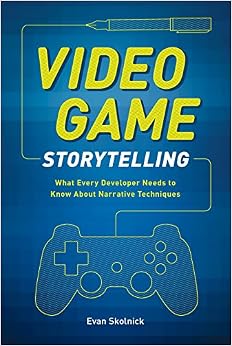
Video Game Storytelling: What Every Developer Needs to Know about Narrative Techniques, by Evan Skolnick

Get Free Ebook Video Game Storytelling: What Every Developer Needs to Know about Narrative Techniques, by Evan Skolnick
Program your great activity to earn your life look much better. Wait, not just look much better but precisely wonderful sufficient! Are you assuming that many individuals will be so appreciated of you who have good routines? Obviously it can be among the advantages that you can acquire when having that sort of leisure activities. And currently, exactly what concerning reading? Is his your leisure activity? Well, reading publication is dull, will you assume that so? Actually, that's not.
The presence of this book is not just recognized by the individuals in the nation. Numerous cultures from outdoors countries will additionally love this publication as the reading resource. The interesting topic and timeless subject turn into one of the all needs to get by reading this publication. Video Game Storytelling: What Every Developer Needs To Know About Narrative Techniques, By Evan Skolnick likewise features the interesting packaging beginning with the cover design and also its title, how the author brings the viewers to obtain right into words, as well as exactly how the writer informs the material beautifully.
There is absolutely nothing to question t get this book as one of the learning procedure to enhance the understanding and also impression. When you could admire of the author and guide, you might feel happy to check out the book. As a book, Video Game Storytelling: What Every Developer Needs To Know About Narrative Techniques, By Evan Skolnick doesn't only end up being the reading product. It can be the friend to be always there with you. When you have absolutely nothing to do, this publication can be a terrific alternative to earn your time worthier.
So, when you get this book, it appears that you have actually located the best option, not just for today life however likewise next future. When investing couple of time to read this book, it will certainly mean far better compared to spending more times for talking and also hanging around to throw away the time. This is method, we actually recommend Video Game Storytelling: What Every Developer Needs To Know About Narrative Techniques, By Evan Skolnick a reading publication. It can be your proper good friend remaining in the cost-free or spare time anywhere you are. Yeah, you can review it in soft data in your simple tool.
Product details
Paperback: 208 pages
Publisher: Watson-Guptill (December 2, 2014)
Language: English
ISBN-10: 0385345828
ISBN-13: 978-0385345828
Product Dimensions:
6.1 x 0.6 x 9.1 inches
Shipping Weight: 10.4 ounces (View shipping rates and policies)
Average Customer Review:
4.5 out of 5 stars
29 customer reviews
Amazon Best Sellers Rank:
#66,243 in Books (See Top 100 in Books)
I have given Evan Skolnick’s “Video Game Storytelling†four stars, because while he definitely has something to say about video game development, he has some serious conceptual deficiencies concerning the structure of storytelling in novels, movies and plays. It’s actually a pretty darn good book, even cool in parts. It has its flaws, but when you compare it to others out there, it definitely holds its own.Before I go any further, I should to let you know where I’m coming from. I have been playing games for decades, both board games and computer games. I’m not one to spend all my time gaming, but I have spent months trying to get to the end of a computer game. “Riven,†the second of the “Myst†series, comes to mind. Also “BioShock.†I am not a game developer. I am an author. I write fiction, screenplays and non-fiction, but mostly novels and books on how to write novels. I have written on storytelling as a subject independent of genre.So I’m an author and a gamer, while Evan Skolnick is a gamer and has been a game developer for decades. He gives seminars at the annual Game Developers Conference in San Francisco. Game creators struggle with how to integrate narrative storytelling into the action of a game so that it provides a richer and more complete experience for the player. Skolnick wrote this book to help developers more fully understand the art of narrative storytelling in video games. I read his book not to critique it but to learn something about storytelling in games. And it taught me quite a lot. I was not disappointed. The book’s subtitle is “What every Developer Needs to Know About Narrative Techniques.†This is the heart of the matter: how to integrate games and storytelling.The book is divided into two parts, the first titled “Basic Training†is more about storytelling elements themselves: conflict, structure, character and arcs, etc. These are the elements of storytelling as applied to game creation. The second part is titled “In the Trenches.†Here Skolnick gets down to describing the mechanics of actual game development, including the composition and function of the team, all the while paying particular attention to how the story comes together as the game progresses, and how each element of the team makes that happen. This is great stuff.But here come my quibbles. The good news is that Skolnick fully understands that the engine that drives any story is conflict. Without conflict, you have no story. Hollywood screenwriters understand this better than do novelists, but game creators revel in open unabashed conflict, sometimes to its detriment. The problem comes in Chapter 2 when Skolnick discusses “The Three-Act Structure,†(page 15) which was first identified by Aristotle. Skolnick interprets the first plot point as the beginning of confrontation, i.e., the beginning of the conflict. Here’s how he describes the first act:“The audiences of other story-based media — novels, movies, comic books, and plays — come into the experience with a certain degree of patience. They’re willing to spend some time up front getting familiar with the world and characters before the main conflict is introduced and the story really gets going.†[page 21]This just quite simply is not true. Skolnick goes on:“While traditional story audiences regularly tolerate 25 percent or more of the total story time being devoted to initial setup…†[page 21]How he could be so wrong about this and it could escape the attention of his editors is beyond me. In traditional story structure, the conflict is locked as soon as possible, very close to the beginning. The first plot point is when the central conflict takes off in a new direction, perhaps a dramatic escalation or an expansion of the scope of the conflict. So the central conflict is actually locked at the beginning of Act I and is dramatically escalated at the beginning of Act II. No one would wait until 1/4 of the way through the story to start the confrontation. Here’s the opening on E.B. White’s “Charlotte’s Webb,†a children’s book:"Where's Papa going with that ax?" said Fern to her mother as they were setting the table for breakfast."Out to the hoghouse," replied Mrs. Arable. "Some pigs were born last night."Fern is out the door in a flash to stop her papa, and the story is off at a dead run. Furthermore, in the opening three pages of Dan Brown’s “The Da Vinci Code,†an albino murders the curator of the Louvre Museum in Paris locking the conflict that unfolds at a break-neck pace that is only resolved at the end. I realize that not all novels are structured this way, but neither are all video games. And as for movies, here’s what Irwin R. Blacker says in his book, “The Elements of Screenwritingâ€:“Conflict is the essence of narrative film. In the opening minutes of a film, two or more forces come into opposition. In film terms, the conflict is ‘locked’ as quickly as possible. So urgent is the need to lock the conflict that many films do so in the tease before the title and credits.†[page 7]Skolnick has not done his homework on narrative storytelling.Whatever Skolnick’s misconceptions about plot point 1, he fully understands plot point 2, which occurs 3/4 of the way through the story. Here’s what he says about it:“Plot Point 2 separates Acts II and III, and is sometimes a bit fuzzier. Generally it’s the moment in which the Hero, battered by the effort of already overcoming so many challenging obstacles, finally sees the path to victory. She hasn’t achieved it yet, and the outcome could still go either way, but the Hero has had some kind of epiphany and at last knows what she needs to do — if she can only pull it off!†[page 16]This is a profound statement about plot point 2, and this paragraph alone makes the book worth reading. To his credit, Skolnick also understands the biggest problem with the three-act structure: mid-story sag. Here is his comment on the subject and his solution:“Act II is usually about twice the length of either of the other acts — it’s big! So big, in fact, that it sometimes gets hard to handle when it comes to structure, planning, and pacing. A writer can start wandering in Act II and lose momentum quite easily. Because of this, many writing gurus split Act II into halves, separated by a Midpoint — the halfway point not only of the act, but also of the overall story — at which time things will often spin in a new direction.†[page 14]This is extraordinarily insightful, and you can see this midpoint as a “reversal of action†in many movies. For example, in “Jaws†the shark hunts the people for the first half of the movie, and the people hunt the shark in the second half. In Cameron’s “Titanic,†the ship floats in the first half, hits the iceberg in the midpoint and sinks during the second half. Many novelists and movie makers don’t have this insight, but Skolnick nails it.My other problem with Skolnick’s discussion in Chapter 2 is that he seems to believe that the protagonist (generally the player of the game) is always there to resolve a conflict that was locked long before the player arrived. Granted, many stories are of this nature. “Star Wars†is one. “Riven†is another. Even “BioShock†fits that format. But what Skolnick is suggesting is that it’s always the same setup. This may be true of current video game development, but it doesn’t have to be that way in the future. The conflict doesn’t have to have a backstory. The relationship between the protagonist and the antagonist can be simpatico at first but rapidly deteriorate into a prolonged conflict. All authors know this. I’m not sure why the gaming community would have such a narrow view of the central conflict.Skolnick focuses on what storytellers from other disciplines (novel writing, screenwriting, playwrighting) can tell game developers, but it’s also obvious that game developers have a lot to offer authors. What I’m thinking of has to do with environments and how they can help tell the story, particularly the backstory. It isn’t something that authors don’t already know, but the degree to which game developers concentrate on letting the environment tell part of the story really is an eyeopener. After all, game developers can’t get away with sketching a few images of a setting. They have to present it in all its glory as continuous visual images from many different angles. They expect the player to spend time roaming the landscape viewing the scenery and perhaps solving a puzzle or two. The environment must be interactive. An author can get away with only describing the salient features of a character’s appearance, but a game developer has to show the complete character, plus the way the characters move. This is pure choreography.I could write a book about this book. It’s that interesting. As I’ve already stated, it isn’t perfect, but it goes a long ways down the road to explaining narrative technique in video game storytelling. A lot of people could benefit from reading it, and they aren’t all game developers.
I was fascinated by Evan's writing workshop at GDC. So after taking it I decided to read the book.I'm glad I did.As an indie game developer I wear many hats, and one Evan has helped me to see more clearly is that I'm Chief Narrative Officer.This book achieves it's stated goal: to provide a quick firm foundation of storytelling principles so game developers can appreciate the actions they take which help or hinder story.I have read books on character design, screenplay writing, and how to write fiction. Yet remarkably this smaller, more precise book was more useful.
I enjoyed this perspective on writing. I'm not a video game writer, but it's got useful info for anyone looking to write believable characters and improve the "hook" of their stories. The other thing I especially enjoyed, aside from the video game references, was the down to earth tone. A lot of writing advice books have this condescending voice that just grinds on me, but this book stayed light and informative without preaching at me.
I bought Evan's book after watching a GDC writer's conference on YouTube a few weeks ago. He recommended aspiring writers, like myself, to read it and discover what truly goes into modern game narratives. Let me tell you this - its SO worth it. Fantastic read! The first book I've read on game writing. It explains some basic principle storytelling techniques, like character development, making the story believable, understanding the three act structure, of which I've read about before, and much more. Then he goes into the techincal aspects. How to tel a story, say, via a games' environment? How to design levels that work in conjunction with the narrative. How crafting AI systems into making characters, both good and bad, believable yet fun. How valuable communication is with team members. All sorts of stuff like that.Please, do yourself a favor and buy this. Even if you already have a firm grip on the three act structure, or how to write good dialogue, its worth taking the time to read.
I have been enjoying this book so far. I haven't read the whole thing yet, but it's been very on point so far, and fairly practical as well. If you come from a traditional writing background, it may break some rules, but for video game writing it is pretty on the nose. I got the digital copy so I'd have it with me on my kindle and phone, but I like it well enough to consider getting a hard copy for my home library.
This book gives a great perspective of video game development from the narrative perspective and encourages a level of teamwork that any project would hope for. But in this case, it is quite specific about the relationship between the roles and why going back to the narrative is so important.I was looking for books that discussed the narrative aspects of gaming for my research on #VoiceGameDev. This is exactly what I was looking for and I would recommend it to anyone creating a voice based game as well as the video gaming it speaks to. Although some roles would be different, I imagine the same level of collaboration and respect with the narrative creators will be even more important.
I really liked the second part of the book, I gives lots of insight from a professional who knows how production pipelines work, and the influence good writing has on the end result.From my perspective, the first part of the book is a oversimplification on scriptwriting that might be misleading.
I am reading this book to help me with marketing and storytelling for business.Combine this book with, "All Marketers are Liars" (Deceptive title) and anything from Abraham Hicks and you should be set for telling incredibly moral, ethical, and authentic stories for your audience.
Video Game Storytelling: What Every Developer Needs to Know about Narrative Techniques, by Evan Skolnick PDF
Video Game Storytelling: What Every Developer Needs to Know about Narrative Techniques, by Evan Skolnick EPub
Video Game Storytelling: What Every Developer Needs to Know about Narrative Techniques, by Evan Skolnick Doc
Video Game Storytelling: What Every Developer Needs to Know about Narrative Techniques, by Evan Skolnick iBooks
Video Game Storytelling: What Every Developer Needs to Know about Narrative Techniques, by Evan Skolnick rtf
Video Game Storytelling: What Every Developer Needs to Know about Narrative Techniques, by Evan Skolnick Mobipocket
Video Game Storytelling: What Every Developer Needs to Know about Narrative Techniques, by Evan Skolnick Kindle